


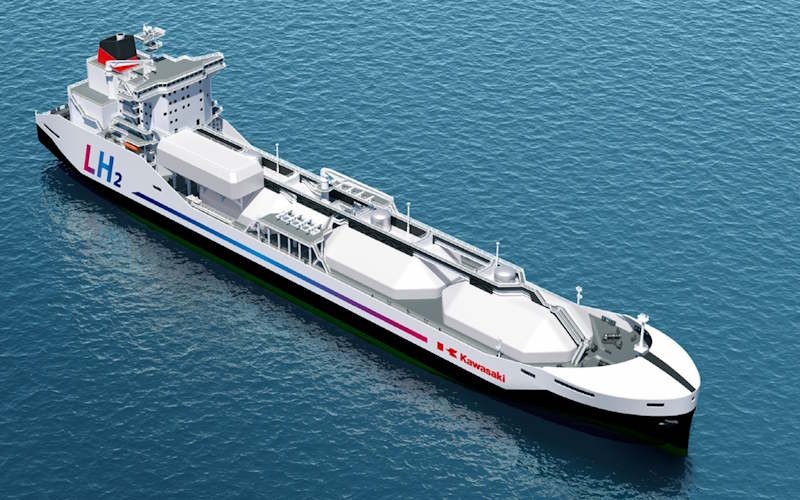
Japan’s Kawasaki Heavy Industries has taken a major step toward scaling the global hydrogen economy. The company has signed an agreement to build the world’s largest liquefied hydrogen carrier, a vessel designed to transport clean hydrogen across continents. The announcement was made in early January 2026.

The new ship will have a storage capacity of 40,000 cubic metres, making it more than 30 times larger than the world’s first liquefied hydrogen carrier. Kawasaki built that earlier vessel, the Suiso Frontier, to test hydrogen shipments between Australia and Japan. The success of those trials helped pave the way for this next phase.
Construction will take place at Kawasaki’s Sakaide shipyard in western Japan. The project is being developed for Japan Suiso Energy, under a state-backed program supported by Japan’s Green Innovation Fund. Sea trials are expected to conclude by the end of fiscal year 2030, according to project disclosures.
The carrier will use advanced insulation systems to minimise boil-off gas, a key challenge in transporting hydrogen at extremely low temperatures. A dual-fuel propulsion system will also be installed. As a result, the vessel will reduce emissions during operations while improving transport efficiency.

Meanwhile, the ship will connect with a new hydrogen terminal under development in Kawasaki City. Together, the infrastructure will test the commercial viability of large-scale hydrogen shipping. This step is seen as critical for building a global hydrogen supply chain.
Kawasaki plans to apply its experience from liquefied natural gas (LNG) carriers to hydrogen transport. The company believes demand will grow rapidly in the 2030s, especially as steel, power, and heavy industry seek cleaner fuels.
If successful, the project could reshape how clean hydrogen moves across borders—and accelerate the global energy transition.