



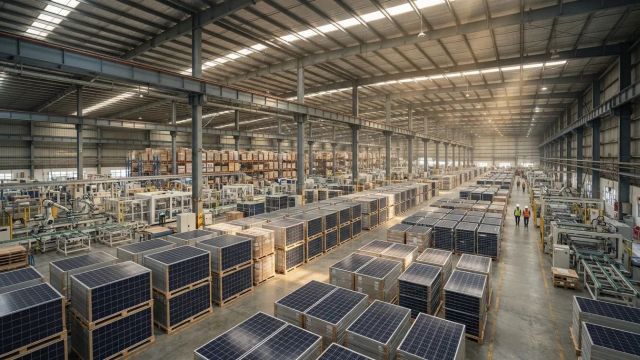
India’s solar manufacturing industry is entering a crucial phase. Years of government support and private investment have helped the country become the world’s second-largest solar PV module manufacturing hub. However, beneath this impressive growth lies a growing concern: India may be building more solar manufacturing capacity than the market can absorb.
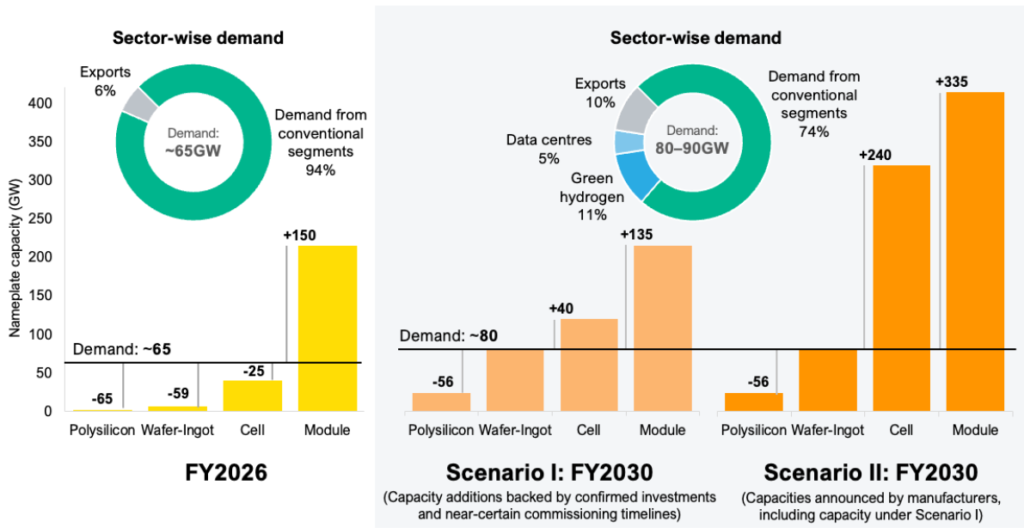
A September 2026 report by the Institute for Energy Economics and Financial Analysis (IEEFA) and JMK Research highlights this imbalance. India’s solar module manufacturing capacity reached 233 GW by June 2026. Yet, factories are operating at just 35–40% of their capacity. For sustainable operations, utilisation generally needs to reach 50–65%.
The gap becomes even more concerning further up the supply chain. India’s module capacity is nearly seven times its solar cell capacity and 116 times its ingot-wafer capacity. As a result, manufacturers remain heavily dependent on imported components, particularly from China.
Too many factories, not enough demand?
Government incentives, the Production-Linked Incentive (PLI) scheme and domestic sourcing rules have encouraged manufacturers to expand rapidly. However, investment has largely focused on module assembly, which requires less capital and technical expertise than producing solar cells, wafers and polysilicon.
The report estimates that another 135 GW of module capacity could enter the market through committed investments. This raises the risk of falling prices, shrinking margins and underused factories.
Smaller manufacturers and older technology-based facilities face particular pressure. Around 45–50 GW of capacity could face consolidation, acquisitions or operational disruption.
Can emerging markets absorb the surplus?
Data centres, green hydrogen and exports could offer some relief. According to IEEFA and JMK Research, these sectors could generate an additional 17–22 GW of annual solar demand by 2030.
India’s growing digital infrastructure is creating fresh electricity demand. Artificial intelligence and cloud computing will accelerate this trend. Green hydrogen projects also need large amounts of renewable power.
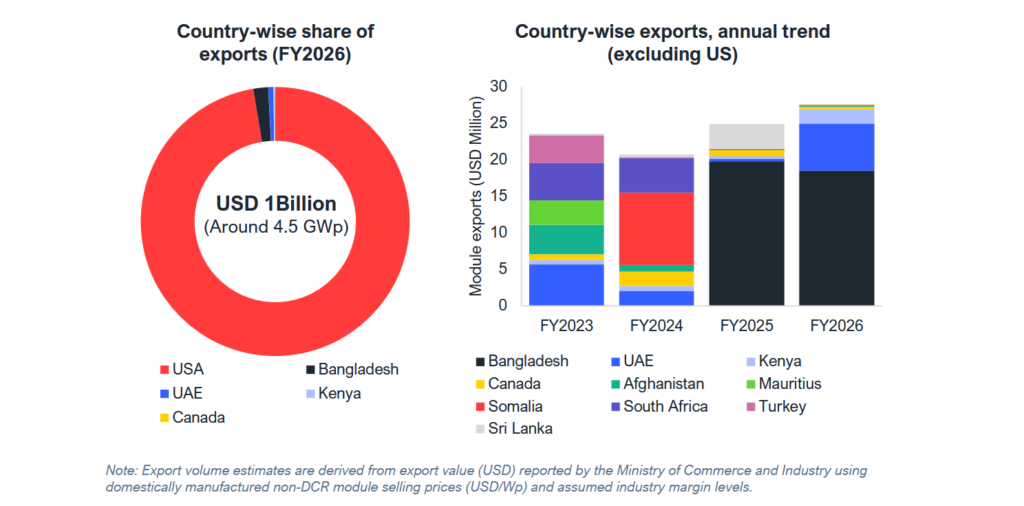
However, these opportunities will not solve the problem overnight. Financing, project execution and supportive policies will determine how much demand actually materialises.
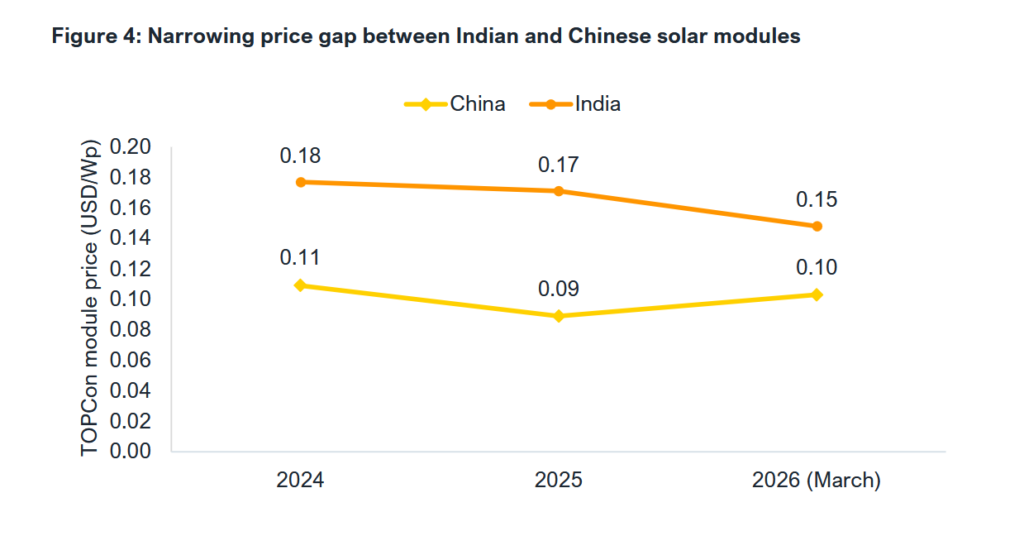
Exports offer another opportunity. Yet, dependence on the US market exposes Indian manufacturers to changing trade policies. Europe, the Middle East and Africa could provide alternative destinations, although Chinese producers retain significant advantages in cost, technology and scale.
The real challenge is competitiveness
India now needs to look beyond adding manufacturing capacity. Greater investment in upstream production, research, advanced cell technologies and export diversification will be essential.
Better transmission infrastructure and faster renewable energy project execution also matter.
India has shown that policy support can build manufacturing capacity. The next challenge is turning that capacity into a competitive, profitable and sustainable industry. The real measure of success will not be how many solar panels India can produce, but how effectively it can compete in the global market.
Reference- IEEFA–JMK Research, September 2026, pv magazine, NITI Aayog, International Energy Agency