




Plastic pollution is no longer simply a waste-management challenge. It has become a question of financial responsibility. A report published in November 2026, Cashing In On Plastic, by Break Free From Plastic, Facing Finance and FairFin, examines how global financial institutions continue to support companies with business models heavily dependent on plastic packaging.
The findings raise an uncomfortable question: how seriously does the financial sector take its sustainability commitments?
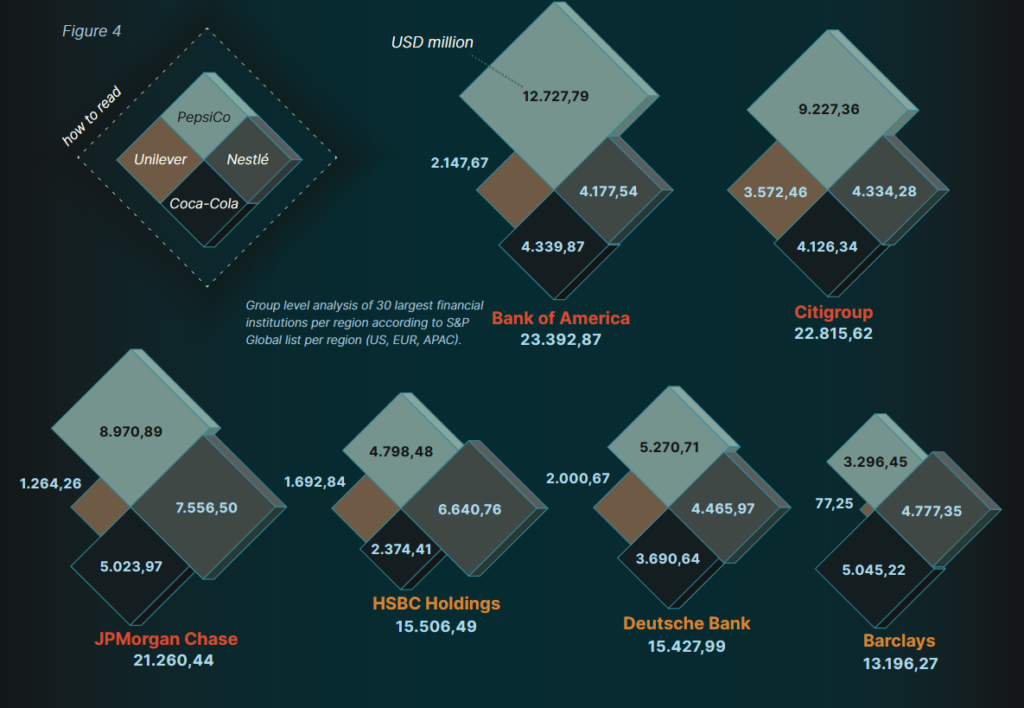
Between January 2019 and May 2025, 61 financial institutions provided US$219.4 billion in credit to Coca-Cola, PepsiCo, Nestlé and Unilever through loans and underwriting. They also held or managed US$138 billion in shares across these four companies as of May 31, 2025.
The study examined 90 major financial institutions across the United States, Europe and Asia-Pacific. Of these, 61 had identifiable lending or shareholding relationships with the companies.

The United States emerged as the largest source of financing. American financial institutions accounted for US$108.3 billion, or 49.4% of total credit. Bank of America led with US$23.4 billion, followed by Citigroup at US$22.8 billion and JPMorgan Chase at US$21.3 billion.
European institutions contributed another US$95.4 billion, representing 43.5% of the total. HSBC and Deutsche Bank were among the five largest creditors, with US$15.51 billion and US$15.43 billion respectively.
On the investment side, UBS Group ranked as the largest managing shareholder, with US$26.4 billion in equity positions across the four companies.
The environmental consequences make these financial figures even harder to ignore.
According to the OECD, global plastic production reached 460 million tonnes in 2019. Yet only 9% of plastic waste was successfully recycled. Without stronger policy intervention, annual production could rise to approximately 1.23 billion tonnes by 2060.
The financial risks extend well beyond the cost of waste management. The report estimates that plastic pollution creates more than US$1.5 trillion in annual health and environmental costs. Corporate liabilities associated with plastics, microplastics and chemical additives could reach US$20 billion by 2030. Under maximum estimates, this figure could rise to US$100 billion.
However, these findings require some context. Corporate lending does not automatically mean that every dollar goes directly towards plastic production. Nevertheless, unrestricted financing can help sustain business models that depend heavily on single-use packaging.
This highlights a growing gap between sustainability promises and financial practices. Many lending policies still lack meaningful conditions around plastic reduction, reuse and refill systems.
Financial institutions have considerable influence over how quickly this changes.
Banks need to introduce measurable plastic-reduction targets into their lending policies. They should also strengthen corporate disclosure requirements and direct more capital towards reusable packaging, refill infrastructure and genuinely circular business models.
Consumer goods companies have an equally important responsibility. Reducing virgin plastic consumption must become a priority rather than relying mainly on recycling claims.

Governments also need to strengthen disclosure rules, introduce binding regulations and ensure that companies are held accountable for the environmental consequences of their operations.
The transition away from plastic cannot rest entirely on consumers, waste collectors and recycling systems. It also depends on where banks invest, whom they finance and what conditions they attach to that funding.
Ultimately, money shapes the direction of industry. If financial institutions continue to reward plastic-intensive business models, sustainability commitments will remain promises on paper rather than measurable environmental progress.
Reference- Break Free From Plastic, OECD report, EU Joint Center Report