



India’s corporate economy is expanding. So is its carbon footprint. A new analysis of India’s largest listed companies reveals an uncomfortable contradiction: business growth is moving faster than corporate decarbonisation.
According to an IIM Bangalore study of Business Responsibility and Sustainability Reporting (BRSR) filings, 53.1% of companies reported an increase in Scope 1 and Scope 2 emissions during FY2024-25. However, the overall emissions increase was 4.29% year-on-year, adding around 53.7 million tonnes of CO₂ equivalent (tCO₂e).
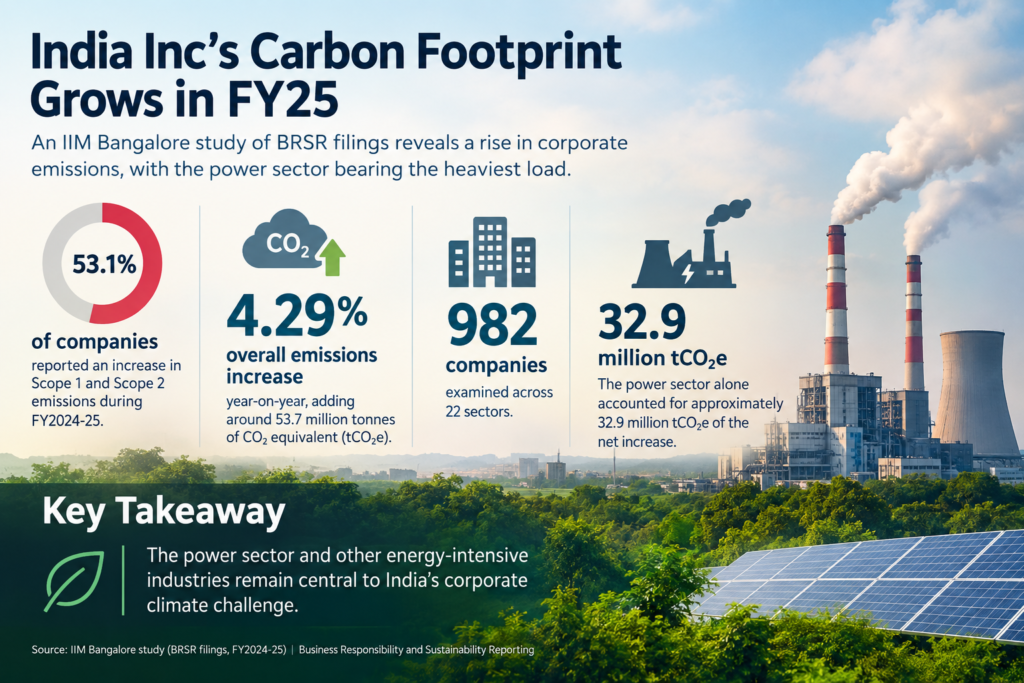
The study examined 982 companies across 22 sectors. The power sector alone accounted for approximately 32.9 million tCO₂e of the net increase. That makes electricity and energy-intensive industries central to India’s corporate climate challenge.
But the larger warning lies beyond factory gates.
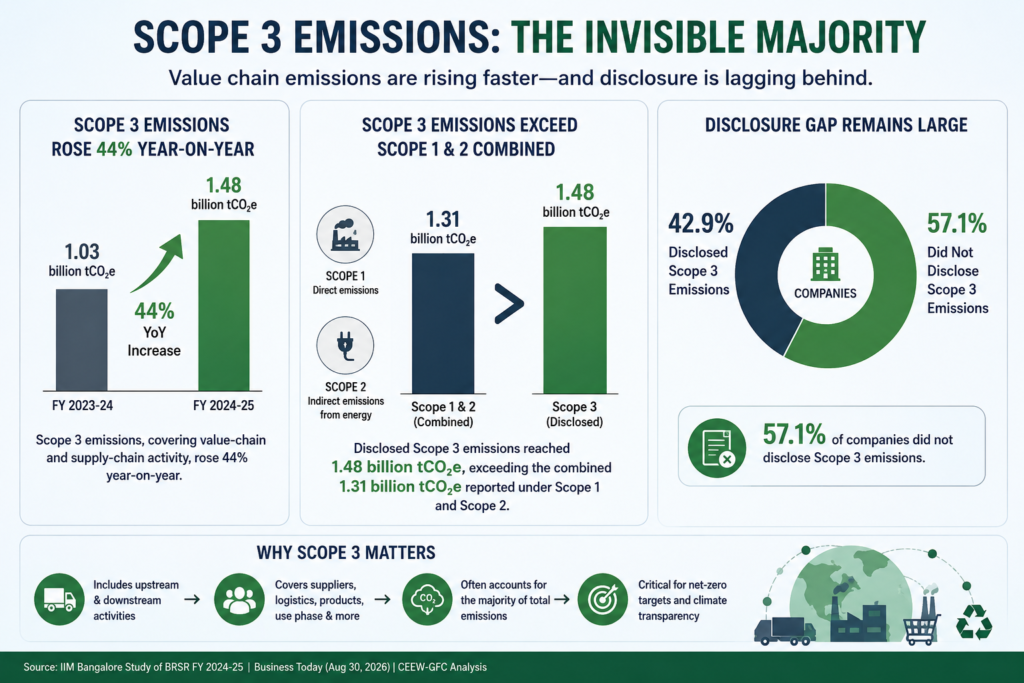
Scope 3 emissions, covering value-chain and supply-chain activity, rose 44% year-on-year. Disclosed Scope 3 emissions reached 1.48 billion tCO₂e, exceeding the combined 1.31 billion tCO₂e reported under Scope 1 and Scope 2. Yet 57.1% of companies did not disclose Scope 3 emissions.
This is where transparency becomes as important as technology.
CEEW’s Green Finance Centre estimates that India’s top 1,000 listed companies account for about 1.3 billion tCO₂e, or 43% of the country’s total emissions. It also notes that BRSR reporting is mandatory for the top 1,000 listed companies by market capitalisation.
Renewable energy adoption remains another weak link. About 68.43% of companies assessed by IIM Bangalore sourced less than 20% of their energy from renewables. Meanwhile, 37.58% reported energy consumption rising by more than 10% year-on-year.
The message is difficult to ignore. India’s corporate climate story goes beyond pledges. Companies must demonstrate their climate performance through energy use, emissions, supply chains and credible disclosures.
As CEEW puts it, corporate emissions disclosures can help “boost accountability.”
For India Inc, the next phase of growth will therefore carry a second balance sheet: the carbon balance sheet. The companies that measure it honestly—and cut it decisively—will be better positioned for a world where climate performance increasingly shapes capital, regulation and competitiveness.
Reference- Business Today, CEEW’s Green Finance Centre Report