




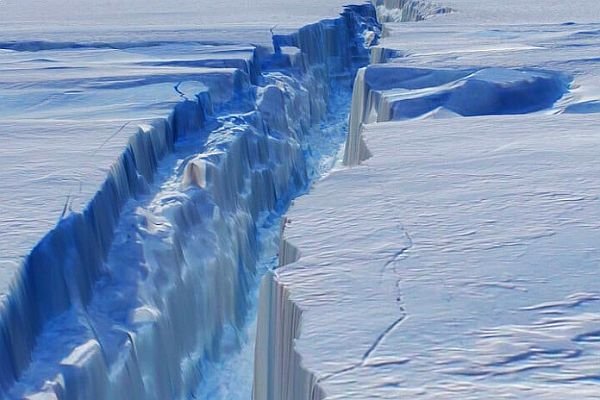
The Thwaites Glacier in Antarctica, nicknamed the “Doomsday Glacier” for its potential to significantly raise sea levels, is experiencing a worrying development. A recent study revealed that warm ocean water is intruding much further underneath the glacier than previously thought, accelerating ice melt.

This “vigorous melting” contradicts earlier assumptions about a stable boundary between the glacier and the seafloor. The research raises concerns that existing climate models might underestimate future sea level rise.
Immensity Under Threat
Thwaites Glacier is colossal, spanning over 74,000 square miles, larger than the state of Florida. However, its size isn’t enough to shield it from a warming climate. To examine this giant, scientists used specialized ICEYE satellites orbiting Earth’s poles. The data enabled researchers to create a 3D model, visualizing the complex interplay of tidal forces beneath the ice sheet.

Grounding Line’s Vulnerability
A crucial area highlighted by the data is the grounding line – the point where the glacier transitions from resting on the seafloor to floating as an ice shelf. Traditionally, the ice below this line was considered protected from warm ocean water.
The study found that high tides elevate Thwaites Glacier by a few centimeters, allowing an influx of warm seawater beneath the ice shelf. This exposes vast amounts of previously shielded glacial ice to a melting threat.
Seawater’s Corrosive Influence
The intruding seawater travels at an alarming rate, nearly four miles within a 12-hour cycle. This rapid flow effectively replaces any freshwater melt with saltier seawater, which has a lower freezing point and accelerates melting. These concerning findings raise similar anxieties about the fate of other glaciers in Antarctica as well. And so those desperate-sounding plans to insulate Thwaites glacier sound more appealing by the minute.
Reference- CNN, Futursim, Journal Proceedings of the National Academy of Sciences, Britannica, ScienceDaily