




Aviation’s climate impact extends beyond carbon emissions. Moreover, a growing body of research shows that contrails—thin clouds formed by aircraft—play a major role in global warming. In response, a recent initiative led by Google highlights a practical solution.
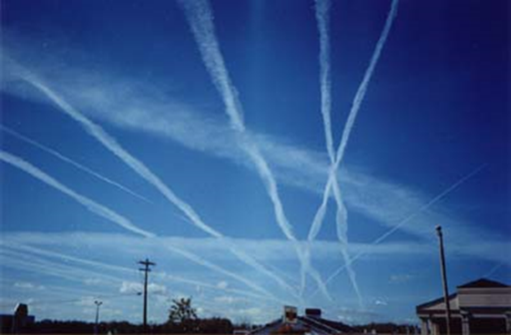
Google worked with airlines to reroute more than 100 flights to avoid contrail-forming zones. The results suggest measurable climate gains with minimal operational disruption.
Contrails trap heat in the atmosphere. As a result, their warming impact can rival aviation’s carbon dioxide emissions over shorter time-frames. Studies estimate that contrails can account for up to 33–63 percent of aviation’s warming effect over 100 years. Moreover, over shorter periods, the impact can be even higher.
However, the problem is concentrated. Only 2–3 percent of flights generate around 80 percent of contrail warming . This creates a clear opportunity for targeted intervention.
Google’s approach uses artificial intelligence (AI) to predict atmospheric conditions where contrails form. Flights are then slightly adjusted. These changes are small. Yet the impact is significant.
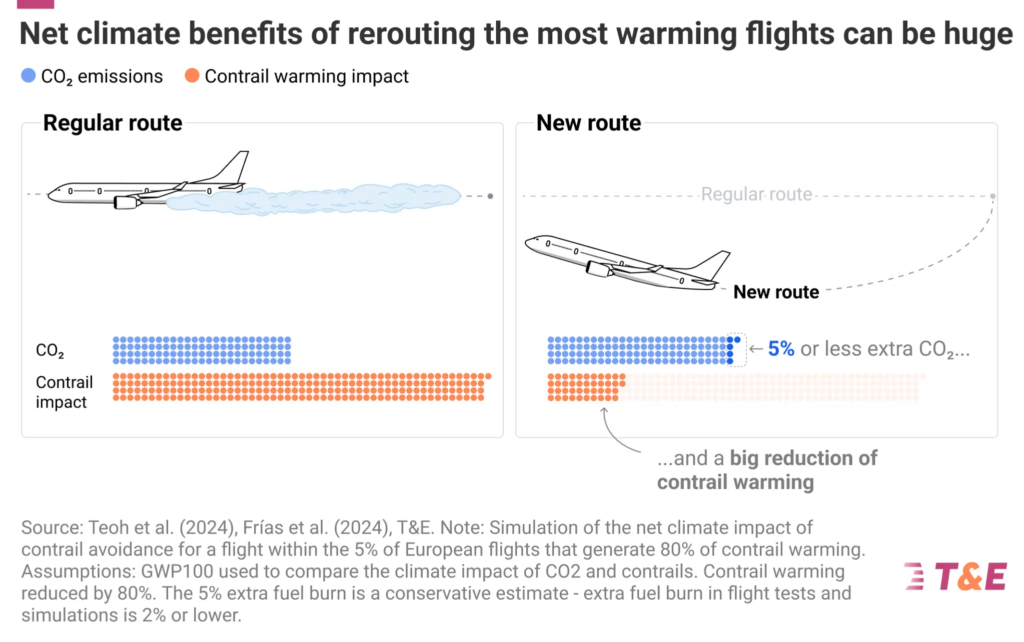
In earlier trials with American Airlines, researchers cut contrail formation by more than 50 percent, while fuel use increased by only about 2 percent. At scale, fuel impact could fall to just 0.3 percent, since only a fraction of flights require rerouting.
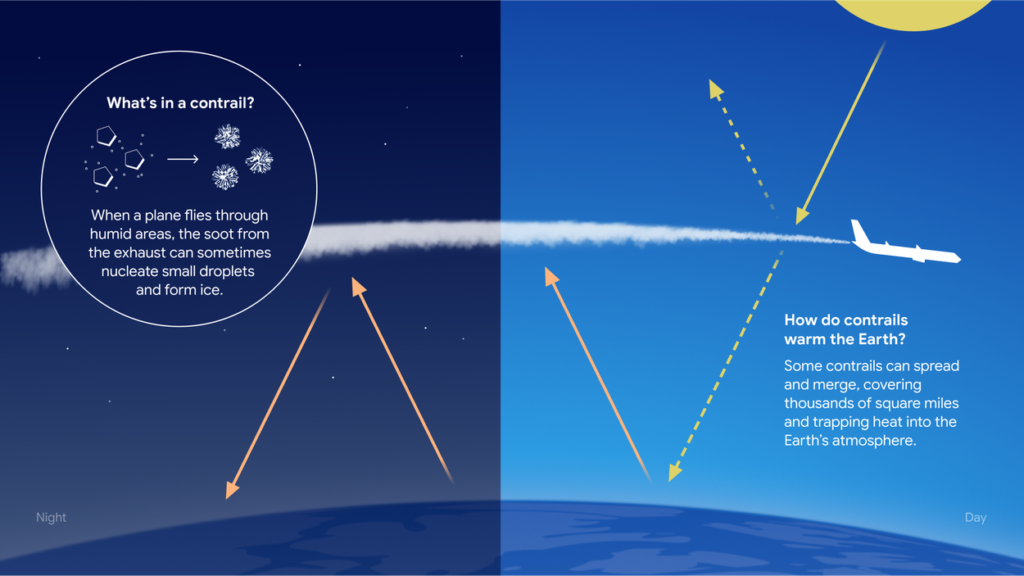
This balance matters. Aviation faces pressure to decarbonise. Yet long-term solutions such as sustainable fuels remain costly. Contrail avoidance offers a near-term option.
Research suggests that even minor flight adjustments can deliver large benefits. In some simulations, contrail warming was reduced by up to 72 percent with minimal extra fuel burn . Costs are also low, estimated at $5–25 per tonne of CO₂ equivalent .
Importantly, these interventions are already feasible. For instance, weather models can identify contrail-prone regions. Consequently, airlines can adjust flight paths in real time. However, the technology exists, and adoption remains the key challenge.
Still, trade-offs exist. Flights require slight increases in fuel use. Air traffic controllers must maintain coordination. These constraints limit immediate scale-up.
Yet the broader implication is clear. Aviation’s climate strategy is shifting. It is no longer focused only on fuel. Operational changes are gaining importance.
Google’s trial signals a quiet transition. Small changes in flight paths can deliver outsized climate benefits. If scaled globally, such measures could reshape aviation’s environmental footprint.
Reference- New Scientist, Reuters, Resources For The Future, Investopedia