



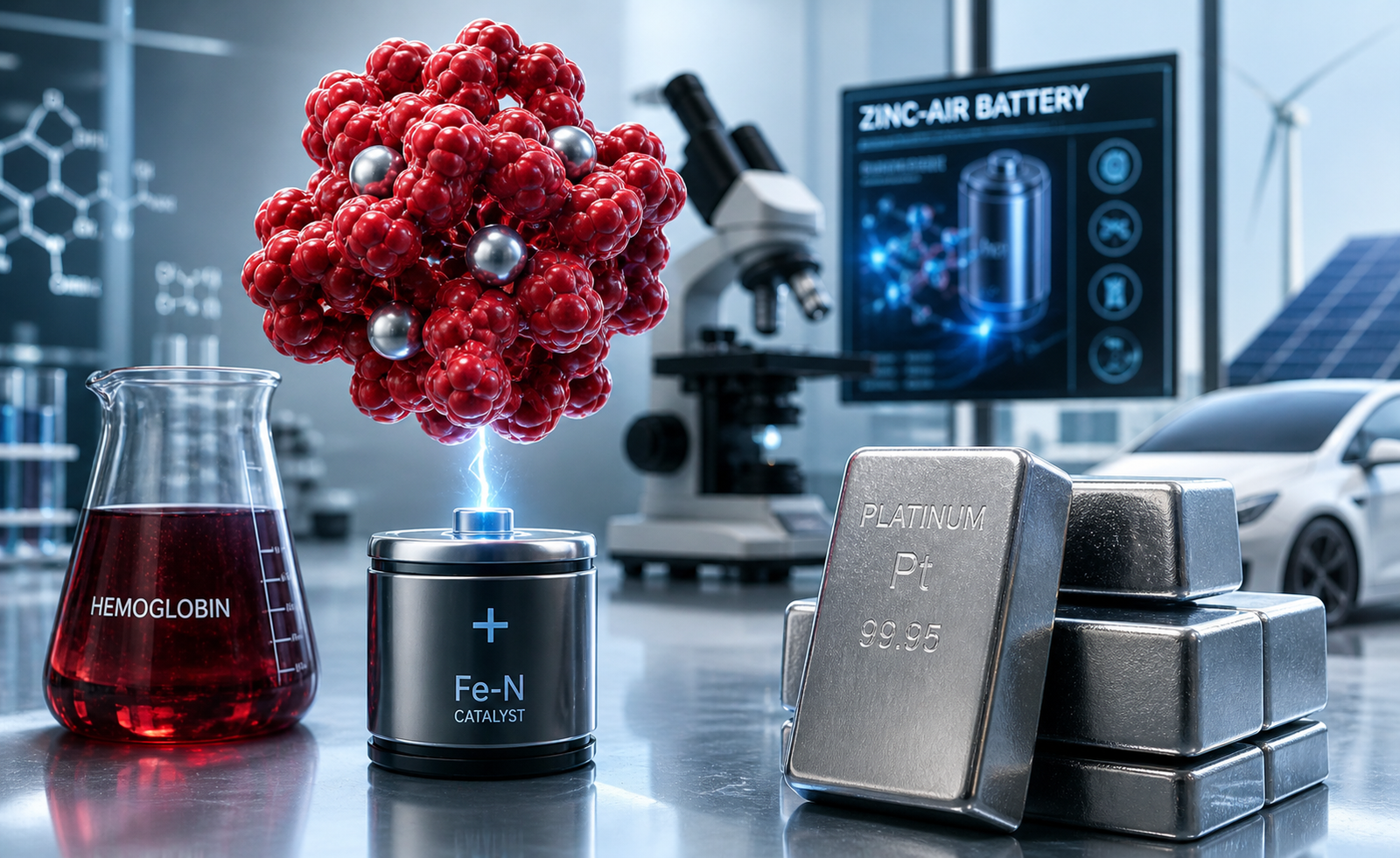
The search for cheaper, stronger batteries may have found an unlikely ally: hemoglobin, the iron-rich protein that gives human blood its red color.
Scientists are now using hemoglobin’s molecular structure to design advanced electrocatalysts that can replace platinum in metal-air battery systems. That matters because platinum remains one of the costliest bottlenecks in modern electrochemistry.
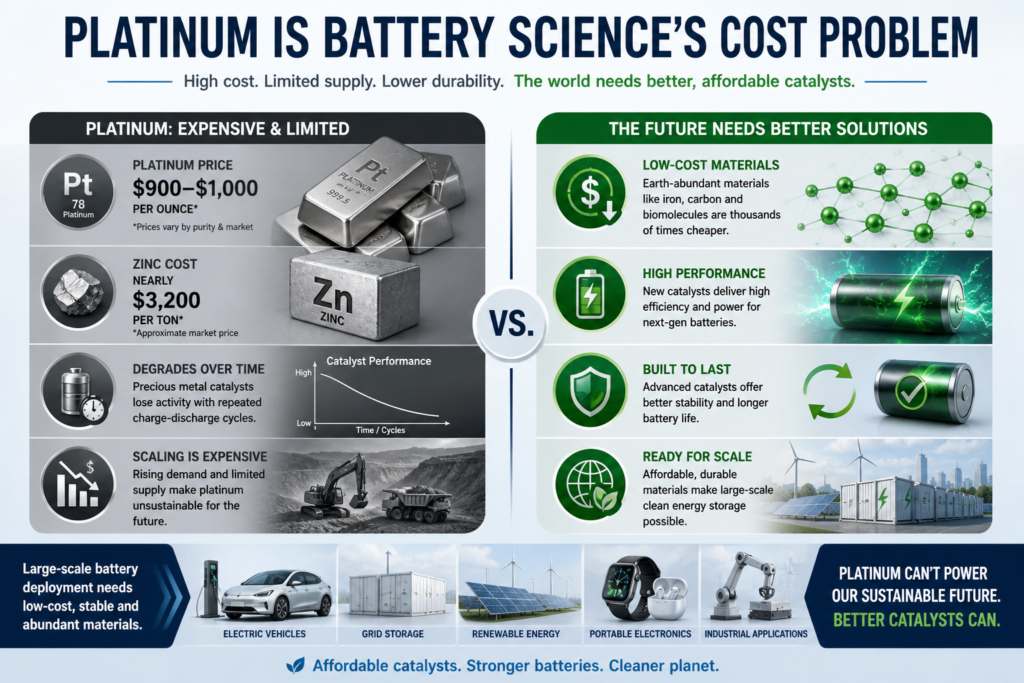
Global platinum demand in energy technologies alone is valued in the trillions over coming decades, while the metal trades at nearly $900 to $1,000 per ounce depending on purity and industrial grade.
A report highlighted that hemoglobin-derived catalysts, when paired with optimized electrolytes, have delivered record voltage performance in experimental zinc-air batteries—a category widely viewed as critical for long-duration storage, electric mobility and distributed backup systems.
Unlike platinum, hemoglobin contains naturally coordinated iron atoms. Researchers say these iron-nitrogen active sites mimic the oxygen reduction behavior needed inside next-generation batteries. In simple terms, nature has already engineered a low-cost catalytic template.
Researchers said durable, highly active oxygen electrocatalysts are essential for scaling rechargeable zinc-air batteries beyond expensive precious-metal catalysts.
That race is urgent. Platinum-based systems degrade under continuous cycling and remain expensive to scale. A January 2025 Nature Communications study also confirmed that platinum nanocatalysts undergo oxide phase transitions even below expected operating voltage, which reduces long-term reliability in fuel-cell style environments.
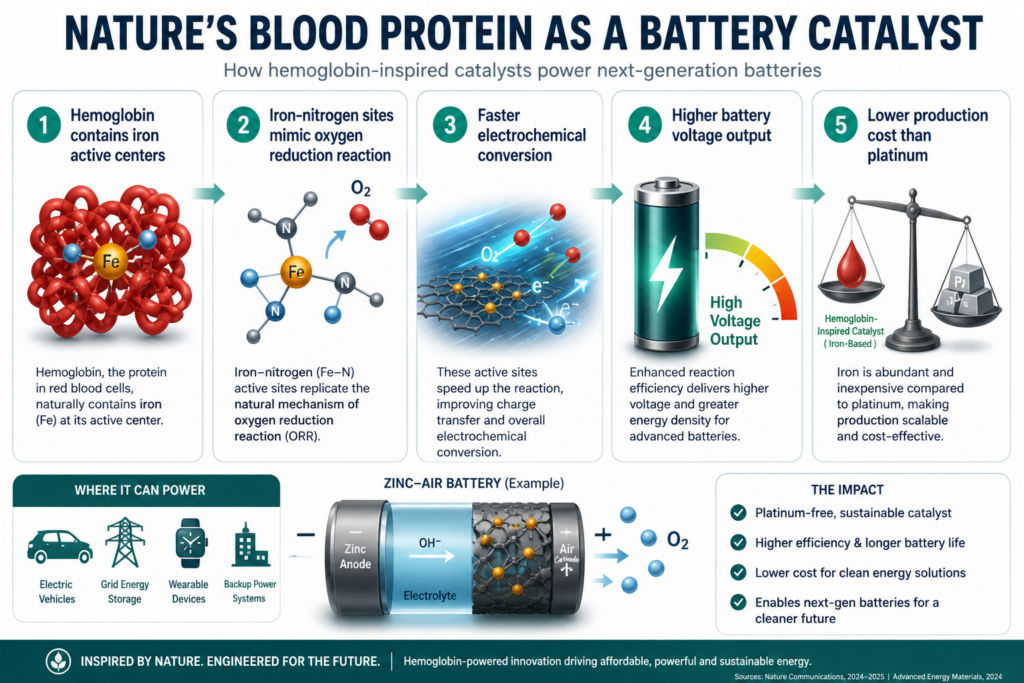
Hemoglobin-inspired alternatives offer two advantages.
First, raw material costs fall sharply because iron is thousands of times cheaper than platinum. Second, bio-inspired catalysts can be manufactured through lower-temperature synthesis routes, cutting production energy.
This is not a laboratory curiosity anymore. Researchers across Asia, Europe and the United States are aggressively pursuing platinum-free battery chemistries as storage demand rises with electric vehicles, AI data centers and renewable grids.

However, commercialization still needs durability validation at industrial scale. Lab voltage records do not automatically translate into decade-long field performance.
Yet the direction is unmistakable.
After centuries of mining rare metals for power storage, battery science is beginning to copy biology instead. And human blood may help solve one of clean energy’s most expensive material problems.
Reference- Nature Communications, MSN Health, Popular Science, SciTechDaily