



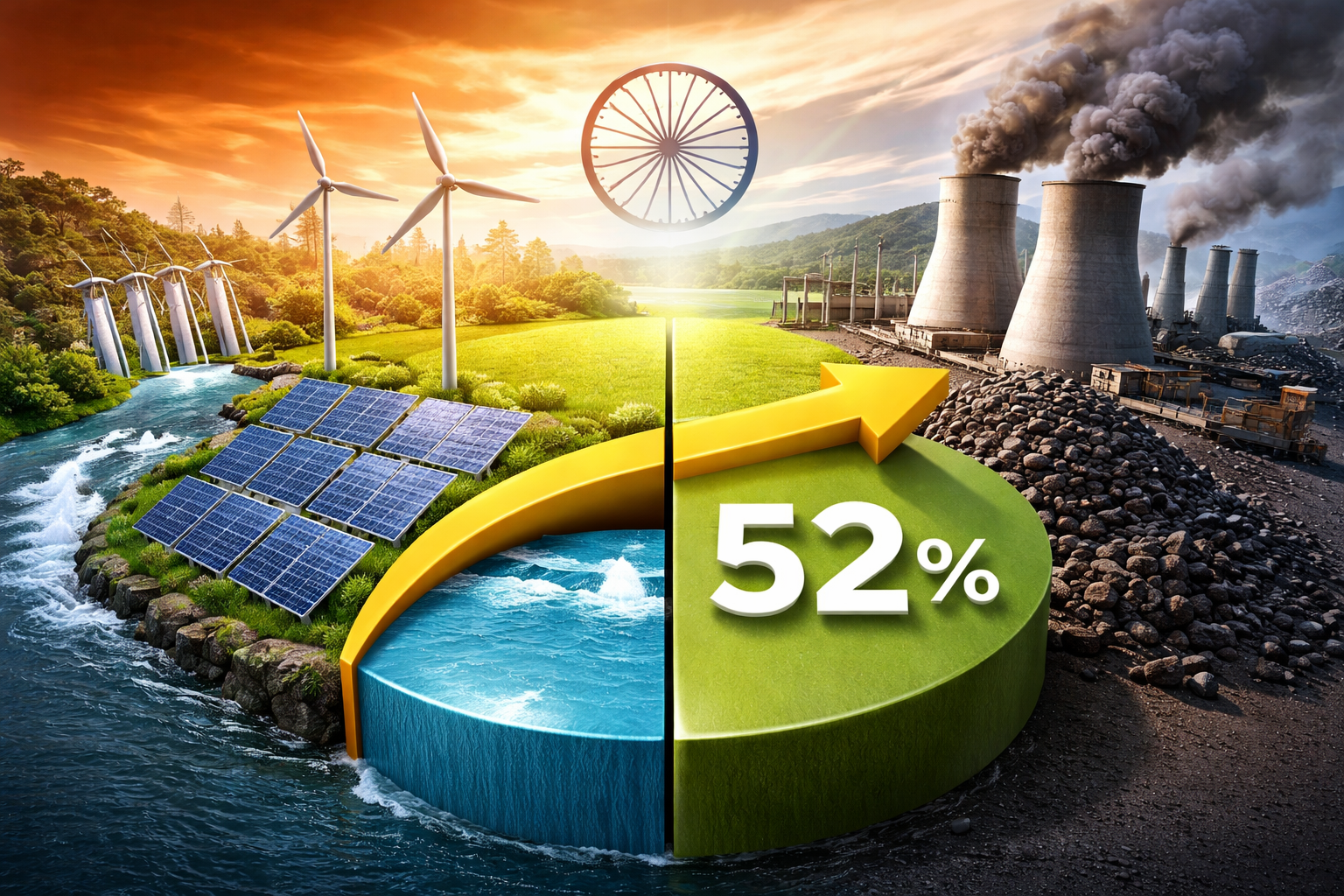
India’s clean energy transition has hit a key milestone. Non-fossil sources now account for 52.3% of total installed power capacity as of January 2026. The country’s total installed capacity stands at about 520.5 GW. Of this, nearly 271.9 GW comes from non-fossil sources, including solar, wind, hydro and nuclear.
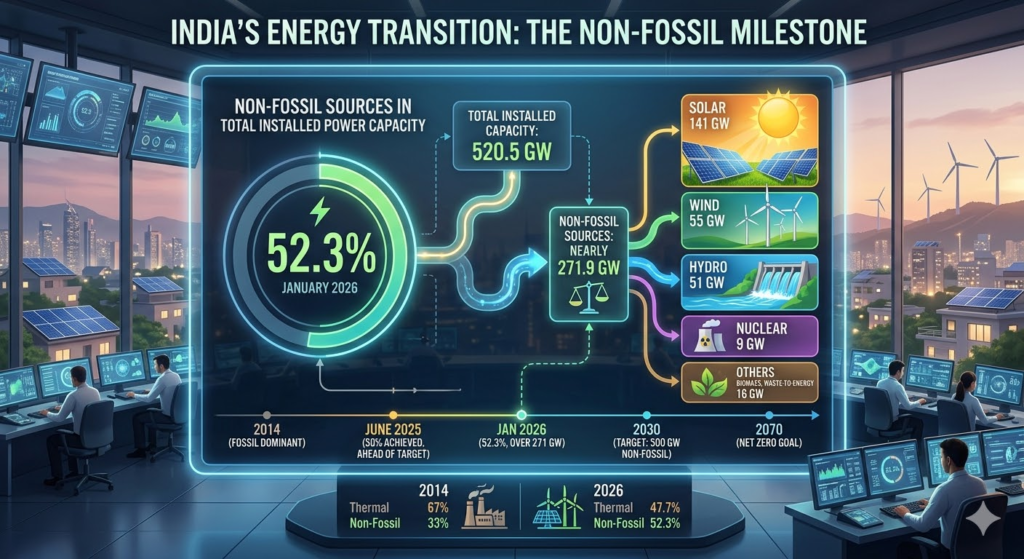
This shift has been driven largely by record renewable additions. India added over 52.5 GW of power capacity in the first ten months of FY26. About 75% of this came from renewables, led by solar installations.
Solar remains the backbone of this growth. Industry data shows it contributed the bulk of the 39.6 GW renewable capacity added during the period.
Government data confirms that non-fossil capacity has now overtaken fossil fuels in the installed mix. Fossil-based capacity stands at about 248.5 GW.
However, the transition is not complete. Coal still supplies the majority of electricity generated in India. This highlights a gap between installed capacity and actual generation.
The Economic Survey 2026 noted that India crossed the 50% non-fossil capacity mark ahead of its 2030 target. It called the shift “structural”. Experts say grid constraints and storage gaps remain key challenges. Renewable energy is variable. This limits its share in actual electricity output.
Policy momentum remains strong. India is targeting 500 GW of non-fossil capacity by 2030. Long-term projections suggest this could rise to 786 GW by 2036. For now, the milestone signals progress. But it also underlines a reality. Installed capacity alone does not define the energy transition.
Reference- Mercom India, JMK Research, India Today, Press Information Bureau, The Economic Times