



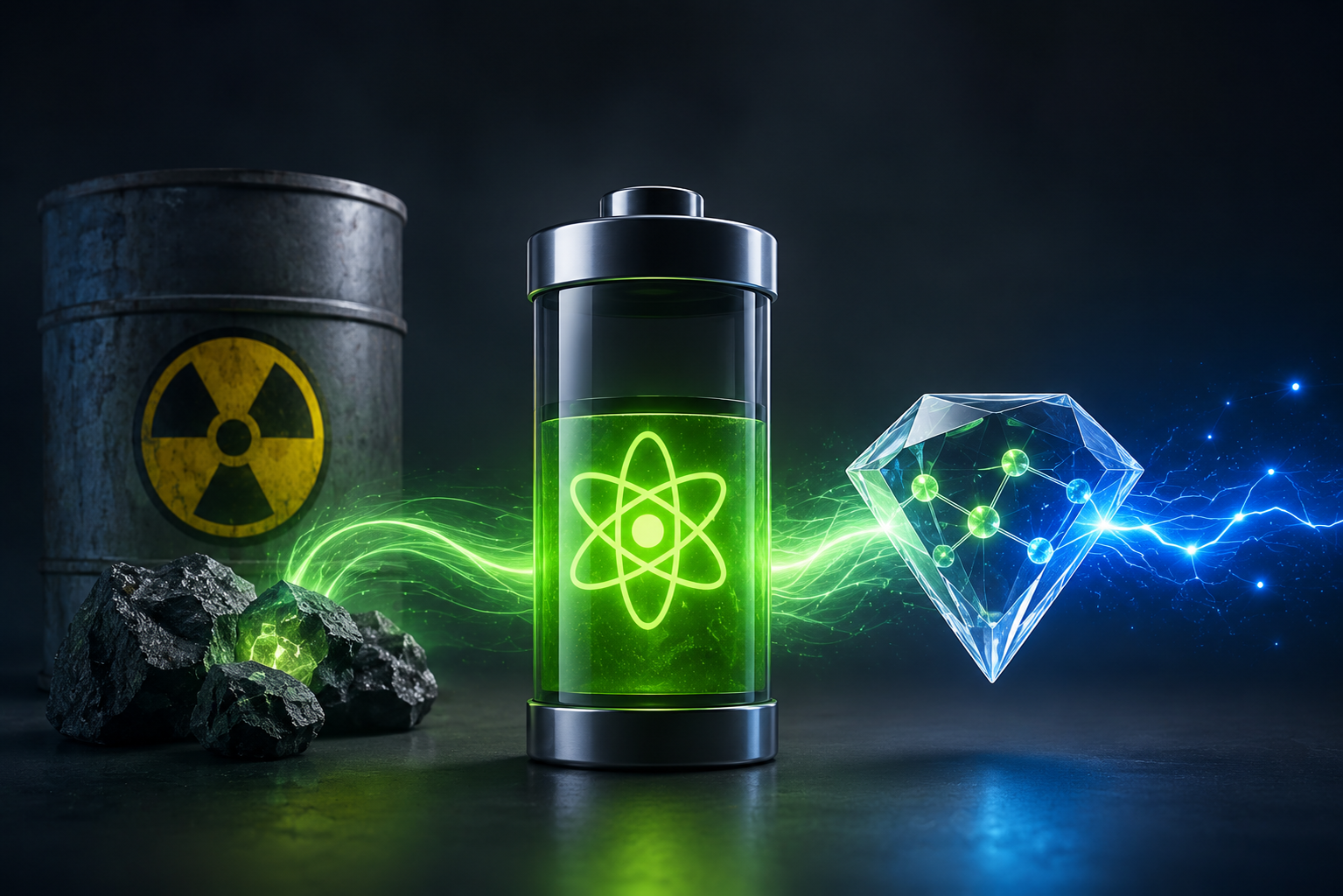
Imagine a battery you never have to charge. One that just keeps working — not for years, but for thousands of years. That’s exactly what scientists in the UK are trying to build, and the idea is as wild as it sounds.
Researchers at the University of Bristol are developing what they’re calling a “diamond battery.” The concept tackles two major problems: managing nuclear waste and powering devices for decades without recharging or battery replacement.
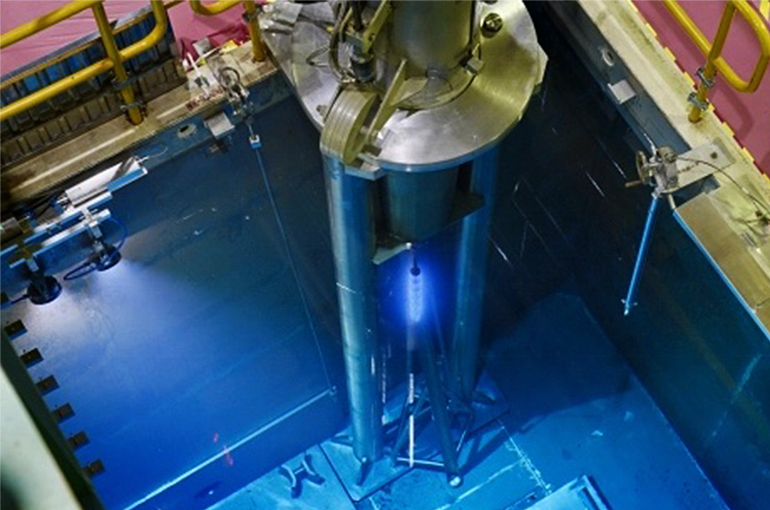
Here’s where it gets clever. The UK has nearly 95,000 tonnes of radioactive graphite waste from nuclear reactors. Scientists are now extracting Carbon-14 from this waste and using it as a fuel source instead of storing it long term.
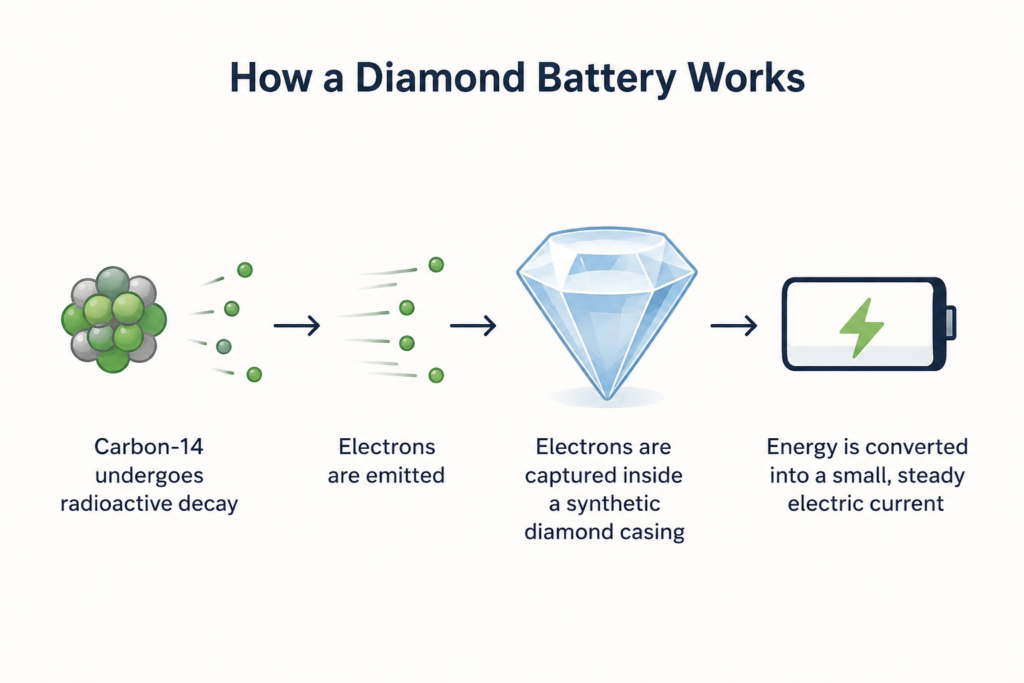
The battery works like a solar panel. However, instead of capturing sunlight, it converts energy released during the natural decay of radioactive atoms into a steady electric current. The Carbon-14 is safely sealed inside a synthetic diamond casing that also helps generate power.
Professor Tom Scott describes it as “direct electricity generation” with no emissions and no maintenance required. No moving parts, no charging, no fuss.
Now, before you picture this thing powering your phone — it won’t. The power output is pretty modest. One gram of Carbon-14 produces about 15 joules of energy per day, far less than a standard AA battery. So this isn’t going to revolutionize electric vehicles or consumer electronics anytime soon.
But that’s not really the point. Think about the situations where swapping a battery is genuinely difficult or even dangerous — a pacemaker inside someone’s chest, a sensor buried in a remote location, a satellite drifting through deep space.
Scientists believe diamond batteries could power these devices for centuries without maintenance, making them ideal for applications where long life matters more than high power.
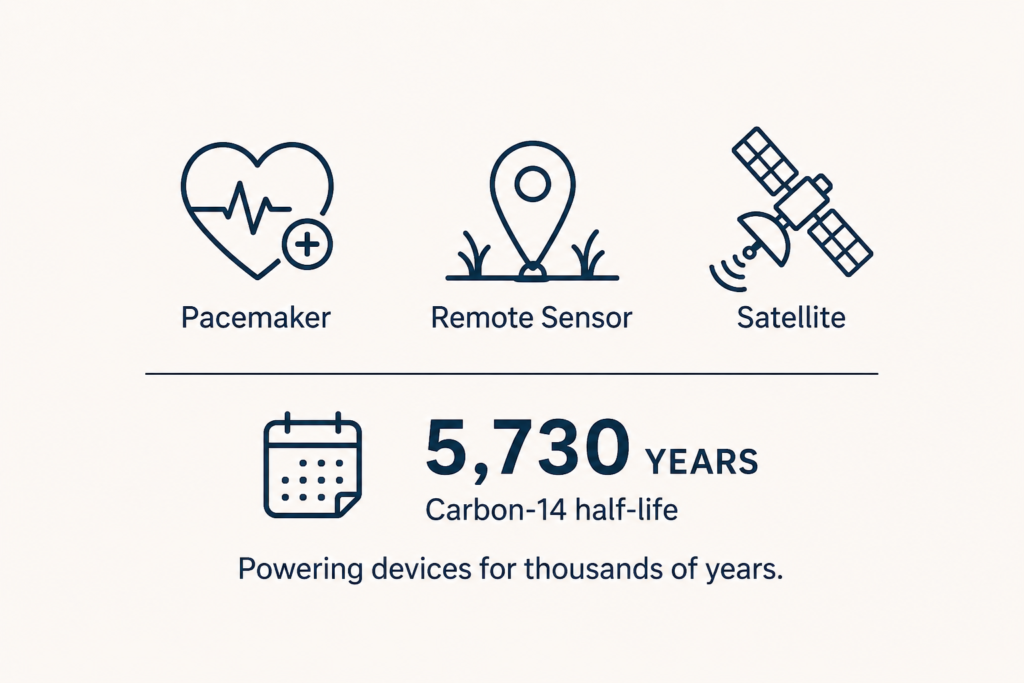
And when they say long-lasting, they really mean it. Carbon-14 has a half-life of 5,730 years, meaning these batteries could keep generating electricity for thousands of years — far longer than any conventional battery.
The technology is still in development, and there’s plenty of work left before diamond batteries show up in real-world devices. But interest is growing fast, and it’s easy to see why. As the world seeks cleaner and longer-lasting energy solutions, turning nuclear waste into a durable power source is emerging as a promising innovation.
Reference- University of Bristol, Journal of Materials Chemistry, Live Science, Gadgets 360