



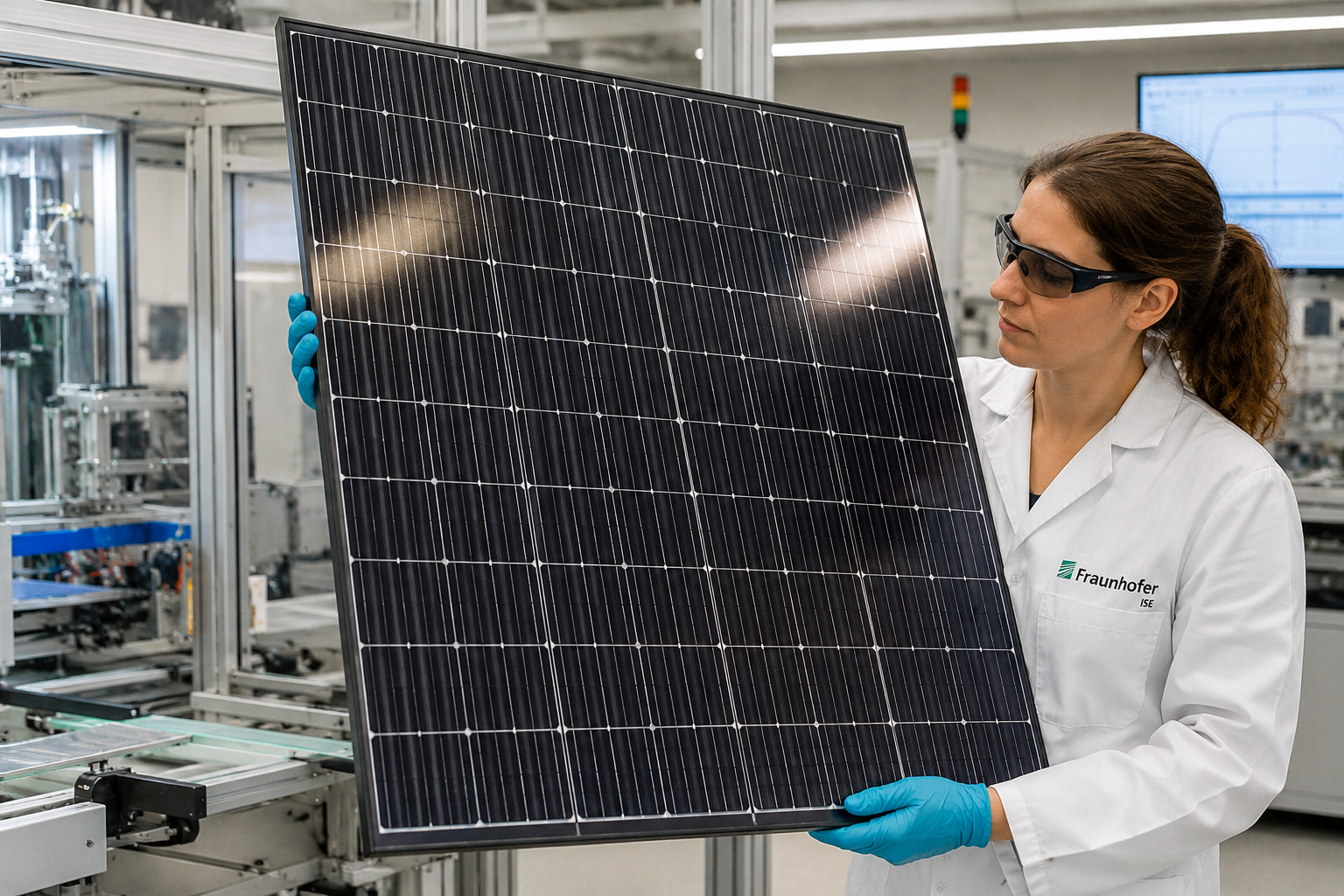
Fraunhofer ISE just did something worth talking about. Their III-V germanium solar module hit 34.4% efficiency — and that’s not just a number. It actually beats their own record of 34.2% from earlier this year in 2026. Breaking your own record twice in the same year is a sign that something real is happening in the lab.
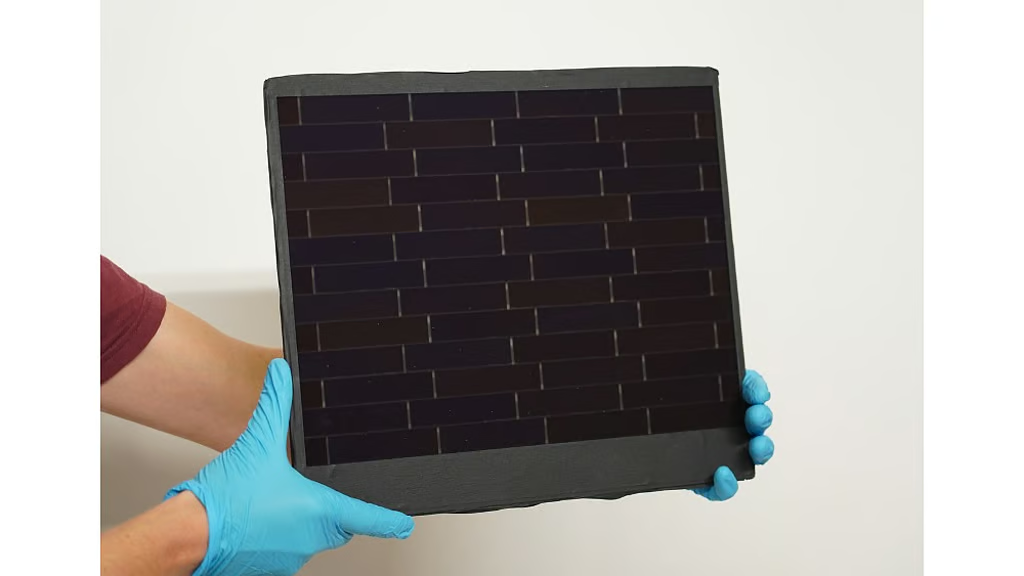
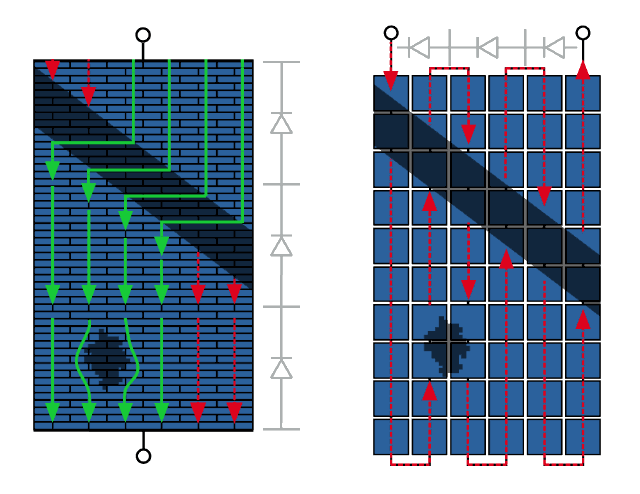
So how did they pull it off? The secret is something called shingle-matrix technology. Instead of using whole cells the traditional way, scientists cut them into narrow strips and arranged them the way roof shingles overlap each other. That simple-sounding change eliminates the metal ribbons that used to eat up space, reduces shading across the panel, and lets the active area of each cell actually do its job. Nothing goes to waste.
The cells themselves came from AZUR SPACE, a company with deep roots in space technology. They originally built this kind of triple-junction cell for satellites — then engineers figured out how to adapt them for ordinary sunlight here on Earth. Temicon contributed anti-reflective coatings to squeeze out even more performance. Fraunhofer ISE described the shingle-matrix approach as “a fundamental departure from traditional photovoltaic module construction,” and honestly, that’s not an overstatement.
Now, here’s some context that makes this exciting. Most commercial solar panels today top out around 23% efficiency. Even the best residential models, like CW Energy’s flagship at 23.04%, are nowhere close to what Fraunhofer just achieved in the lab. That gap represents a massive opportunity — panels that produce significantly more power from the same amount of space.
For a country like India, the implications are enormous. Solar costs are already falling steadily, but higher efficiency changes the math even further. Rooftops generate more power. Farms that face real space constraints get more out of every square meter. Ambitious renewable energy targets suddenly look more achievable without needing to find more land.
The solar world took notice quickly. PV Magazine covered the breakthrough, and TaiyangNews called it the world’s most efficient module. The result grew out of something called the Vorfahrt project, which set out to take proven space-grade cells and adapt them for wide-scale terrestrial use.
That said, a lab record and a product on your rooftop are very different things. Scaling this technology into something affordable takes serious time and investment. These modules aren’t shipping to customers yet. But the direction of travel is unmistakable — efficiency keeps rising, costs keep falling, and the technology keeps maturing.
Policymakers who care about clean energy should, therefore, be paying close attention. After all, supporting R&D at this level isn’t just academic — it’s how you build an industry. Moreover, India has a real chance to lead the next phase of the solar revolution. In that context, this 34.4% milestone lights the way forward.
Reference- Cleantechnica, Fraunhofer Institute for Solar Energy Systems (ISE), AZUR SPACE website, PV Magazine, Reuters